knitr::include_graphics(here::here("posts/2026/graphics/lang1.png"))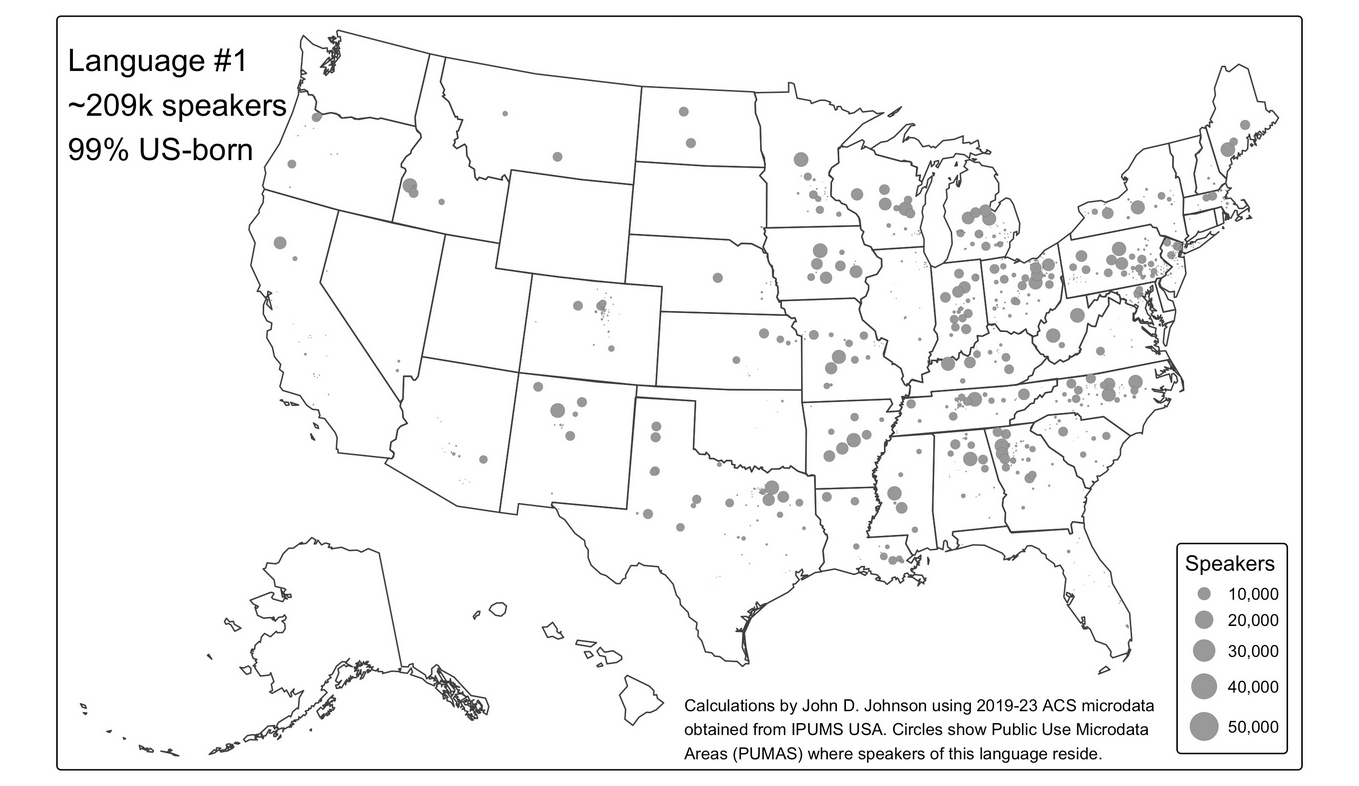
Here’s a bit of trivia: of all the languages spoken in America besides English, which two meet the following conditions?
In other words, what non-English languages have a growing community of American speakers, scarcely any of whom are immigrants? Only two languages of any significant size fit this description.
Can you guess what they are? When I’ve mentioned this to my friends, some of them guess the answer right away, but others never think of it. As a clue, I mapped where the speakers of each language live.
knitr::include_graphics(here::here("posts/2026/graphics/lang1.png"))
knitr::include_graphics(here::here("posts/2026/graphics/lang2.png"))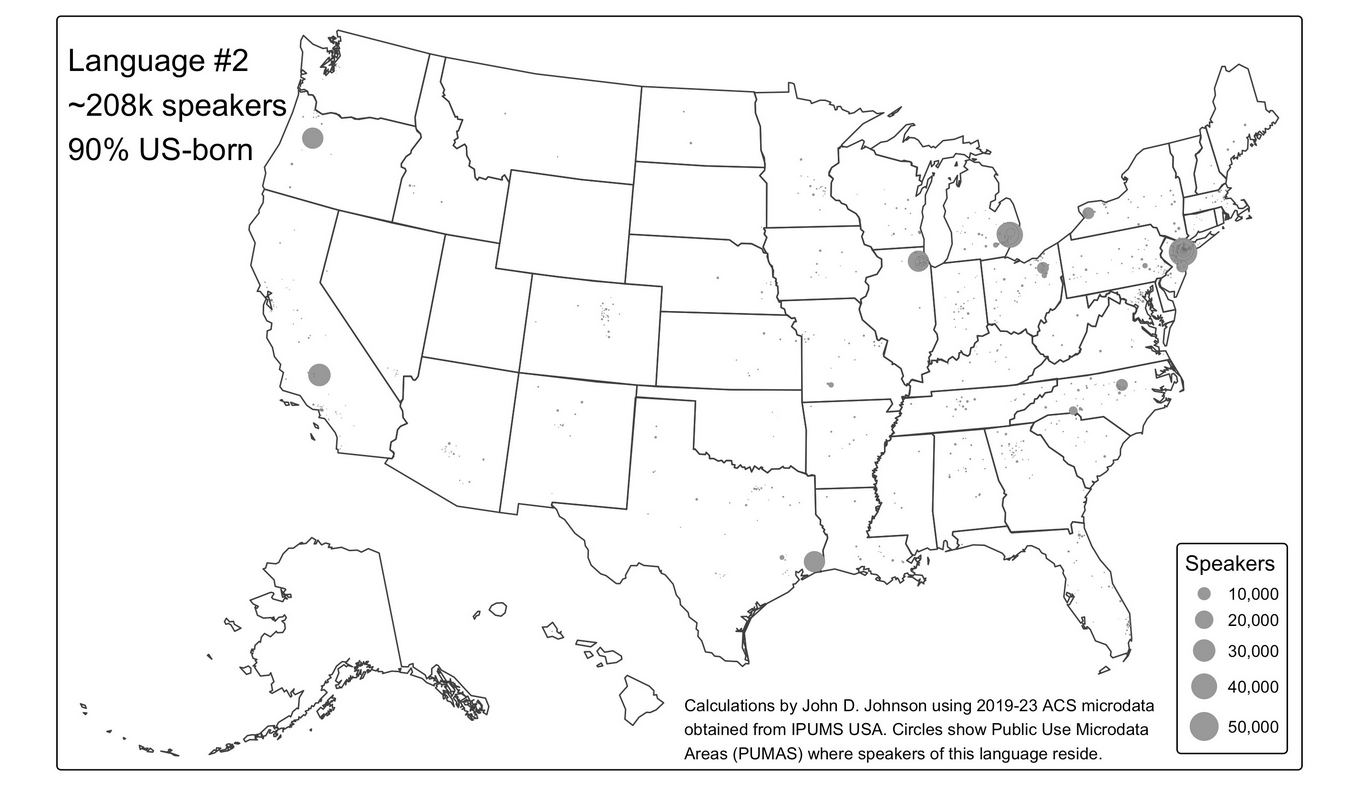
Notice how the two languages, despite having nearly identical numbers of speakers, follow extremely different spatial patterns. Language #1 is scattered across 218 communities of least 1,000 speakers, none of which hold more than 1.1% of the total number of speakers.1 Contrast that to Language #2, where only 25 places have at least 1,000 speakers. In fact, over 2/3rds of Language #2’s speakers live in just 10 communities, each with over 10,000 speakers. The largest has over 48,000.
These languages lie at opposite ends of the urban-rural spectrum, but they do share some other things in common. They are both derived from German and each is spoken by a different insular religious community.
By now you’ve probably guessed. Language #1 is Pennsylvania Dutch (spoken by most Amish groups) and Language #2 is Yiddish (common among some Hasidic Jews).
In the 2000 census data, just 177,000 people reported speaking Yiddish and 83,000 Pennsylvania Dutch. These numbers are just estimates, and I do wonder if the 2000 census might have under-counted of Pennsylvania Dutch speakers.2 Still, the high birthrates among both these groups explain why the total number of speakers is growing. The average age of a Pennsylvania Dutch speaker fell from 29 in 2000 to 24 in 2023. For Yiddish speakers it fell from 48 to 23.
When someone speaks a different language, the census also asks if they speak English “very well,” “well,” “not well,” or not at all. Very few people report speaking no English whatsoever. Among Pennsylvania Dutch speakers, only 30% reported anything besides speaking English “very well.” For Yiddish speakers, 48%.
By “community” I mean Public Use Microdata Area or (PUMA). I calculated these statistics from the Census Bureau’s public use microdata provided by the IPUMS USA project at the University of Minnesota.↩︎
The 2000 census included language questions in the 5% national sample. The 2019-2023 American Community Survey was given to roughly 1% of the population each year.↩︎